
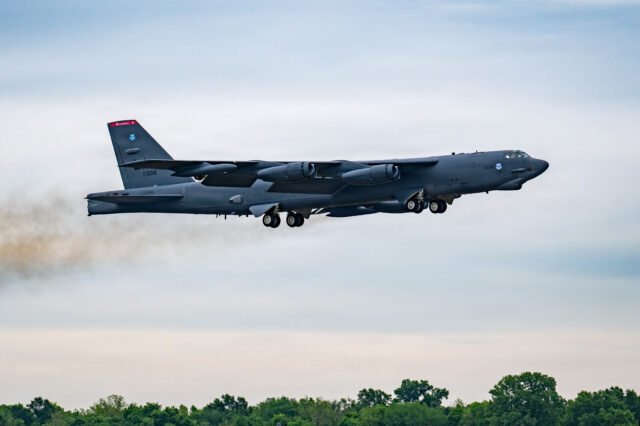
AFWERX SBIR Program Supports B-52 Beyond-line-of-sight Communications
WRIGHT-PATTERSON AIR FORCE BASE, Ohio – AFWERX’s Small Business Innovation Research program helped advance a beyond-line-of-sight communications prototype now employed operationally on the B-52 Stratofortress, supporting the bomber’s long-range strike missions and connectivity with air operations centers.
The B-52 Stratofortress long-range strike and deterrence capabilities have supported the U.S. Air Force since 1955. Designed to deliver nuclear and precision-guided conventional ordnance worldwide, the bomber entered service during the early years of the Cold War and has evolved through successive modernization programs to remain a key component of the Air Force’s long-range strike fleet.
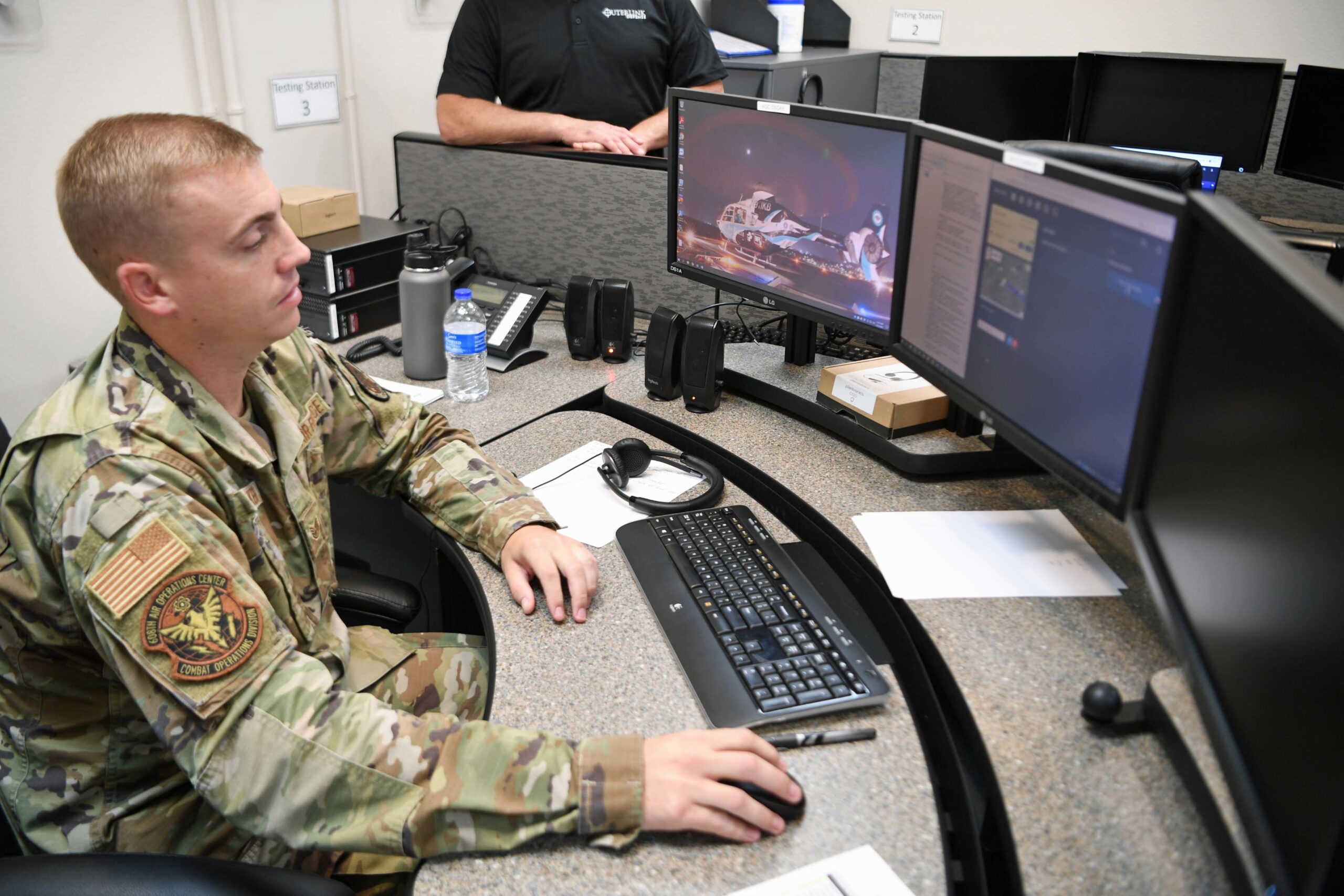
With aircraft expected to remain in the Air Force inventory for decades, continued modernization is critical to maintaining the B-52's effectiveness in increasingly contested operating environments. Effective communications are a key part of that modernization, supporting both operational missions and the training of Airmen who operate and maintain the aircraft.
To address an operational need for beyond-line-of-sight communications, Air Force Global Strike Command pursued a prototype capability for the B-52. In June 2022, the 49th Test and Evaluation Squadron conducted the first airborne demonstration of the system, known as IRIS, on a B-52 at Barksdale Air Force Base, Louisiana. The 608th Air Operations Center assessed voice and data transfers, including images and video, from the aircraft.
The demonstration showed how commercial technology could improve bomber connectivity and support coordination across geographically dispersed air operations centers. Air Force officials also identified the effort as contributing to the B-52’s integration into Joint All-Domain Command and Control.
AFWERX supported the effort through a Small Business Innovation Research Phase II contract to integrate the commercial Outerlink Global Solutions communications system onto the B-52. In 2023, the effort transitioned to a $26 million Strategic Funding Increase (STRATFI) contract, providing additional resources to advance the capability toward operational employment.
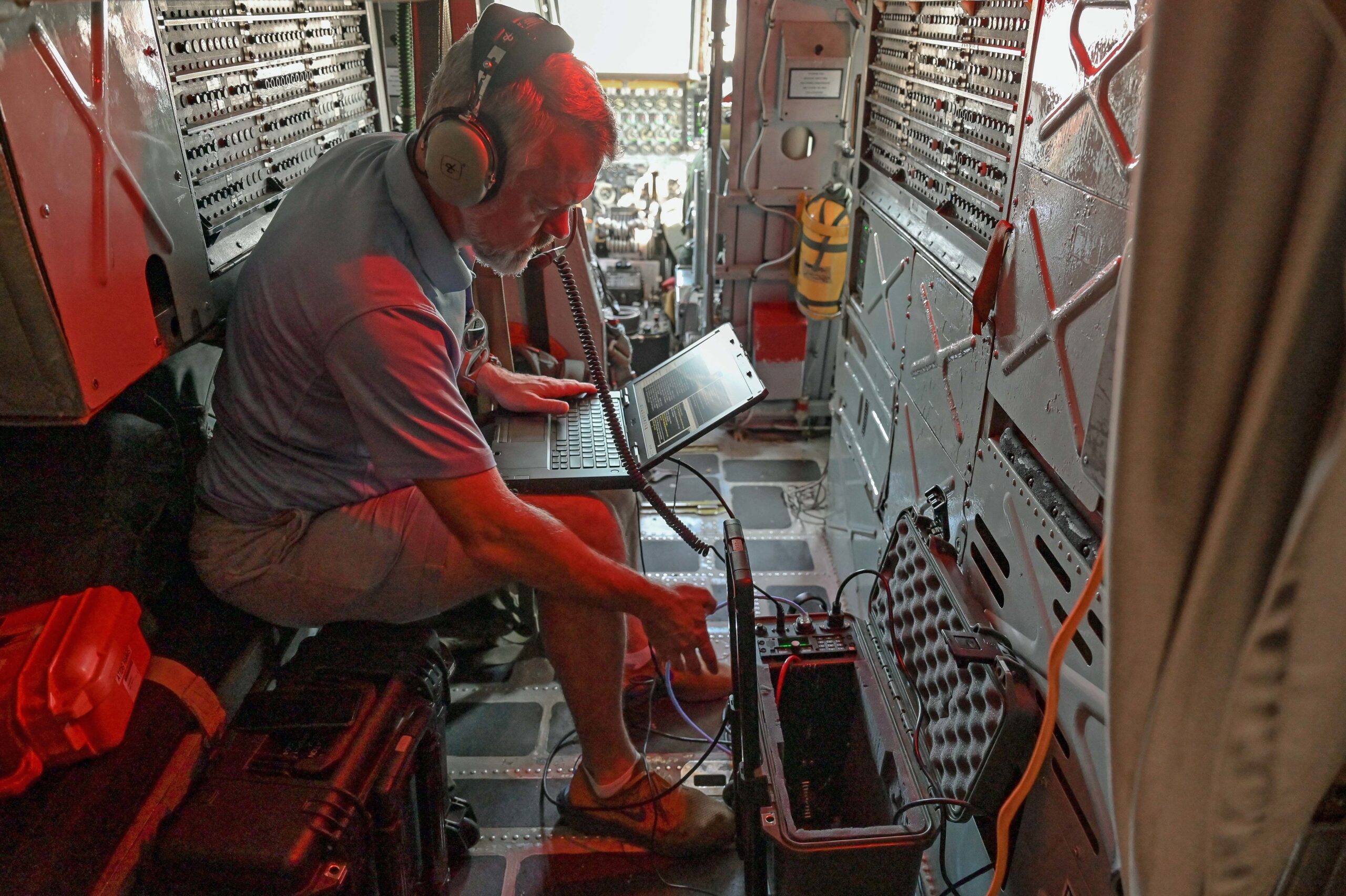
AFGSC/s A5N Rapid Capabilities Division and A5B Bomber Requirements Division led the requirements effort, translating operational needs into technical parameters aligned with B-52 platform constraints and long-term modernization priorities. The B-52 System Program Office, 49th Test and Evaluation Squadron, 608th Air Operations Center and 307th Bomb Wing supported integration, testing and operational assessment
As of April 1, 2026, multiple IRIS kits had been installed on B-52 aircraft and delivered to the 49th TES to support training and operational employment. The system is currently in operational use but remains a prototype under evaluation for consideration as a long-term communication solution.
This effort demonstrates how AFWERX programs can help transition emerging commercial technologies from prototype development toward operational employment in response to identified warfighter requirements. It also illustrates the role of rapid acquisition and collaboration across the Air Force in adapting proven technologies to meet the evolving needs of a long-serving weapons platform.
*Disclaimer: References to non-federal entities do not constitute or imply Department of War or Air Force endorsement of any company or organization.

AFWERX SBIR/STTR-funded Language Platform Draws Defense, Intelligence Interest
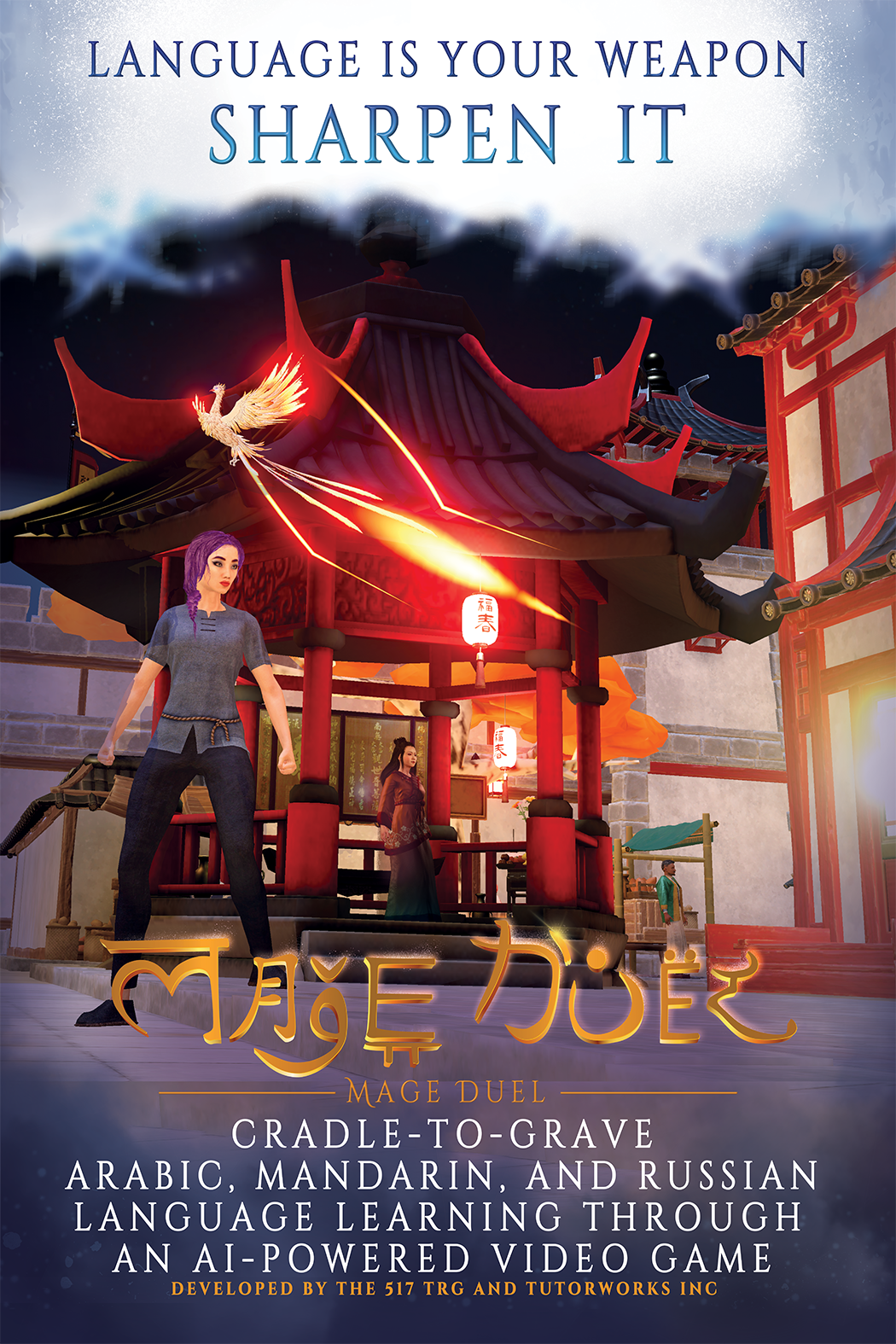
WRIGHT-PATTERSON AIR FORCE BASE, Ohio — AFWERX research and development contracts are helping TutorWorks Inc. advance Mage Duel, an artificial intelligence-enabled language training platform recently demonstrated to more than 20 representatives from defense and intelligence organizations.
Designed to help military linguists develop and maintain their skills, Mage Duel combines immersive gameplay with conversational AI agents. The National Security Agency-facilitated engagement included a demonstration of the platform’s technology and an early Persian, also known as Farsi, implementation developed through AFWERX-funded efforts to identify customer needs.
AFWERX, a division of the Air Force Research Laboratory, connects small businesses with Department of the Air Force mission needs and awards contracts to develop technologies with potential military applications. It manages the department’s Small Business Innovation Research program, known as SBIR, and Small Business Technology Transfer program, known as STTR, helping move technologies from early research toward military use.
For cryptologic language analysts, understanding and interpreting foreign languages is central to the mission. Developing those skills requires extensive vocabulary practice, accurate translation and the ability to apply classroom learning to unfamiliar conversations. Maintaining proficiency requires continued practice throughout a linguist’s career.
Mage Duel makes language practice part of an interactive experience. Learners navigate a fantasy environment where casting spells, completing missions and interacting with characters require spoken and written communication in the language they are studying.
The platform combines four core gameplay activities: AI-driven encounters for understanding and producing language, vocabulary reinforcement activities called thread collection, duels that require translation and language output, and quests that bring those skills together. Players must recall vocabulary and use it in context to progress.
According to TutorWorks, generative AI tutors adjust dialogue difficulty, evaluate pronunciation and grammar in real time, and tailor scenario complexity to individual performance. These features are designed to help users rehearse demanding conversations in a controlled setting while reinforcing formal instruction.
Demonstration participants represented 16th Air Force, Headquarters Air Force A2/6, the 517th Training Group, NSA, the Defense Language Institute Foreign Language Center, the Air National Guard, Army Military Intelligence and Headquarters Marine Corps.
The engagement identified potential applications in operational language training, intelligence organizations and preparation for deployment. AFWERX and TutorWorks are assessing customer demand and exploring potential pilot projects, transition partnerships and follow-on adoption.
TutorWorks received five Phase I and Phase II SBIR awards totaling approximately $2.45 million between 2020 and 2026. The awards, listed in the AFWERX portfolio, funded language learning, adaptive training and cognitive training technologies.
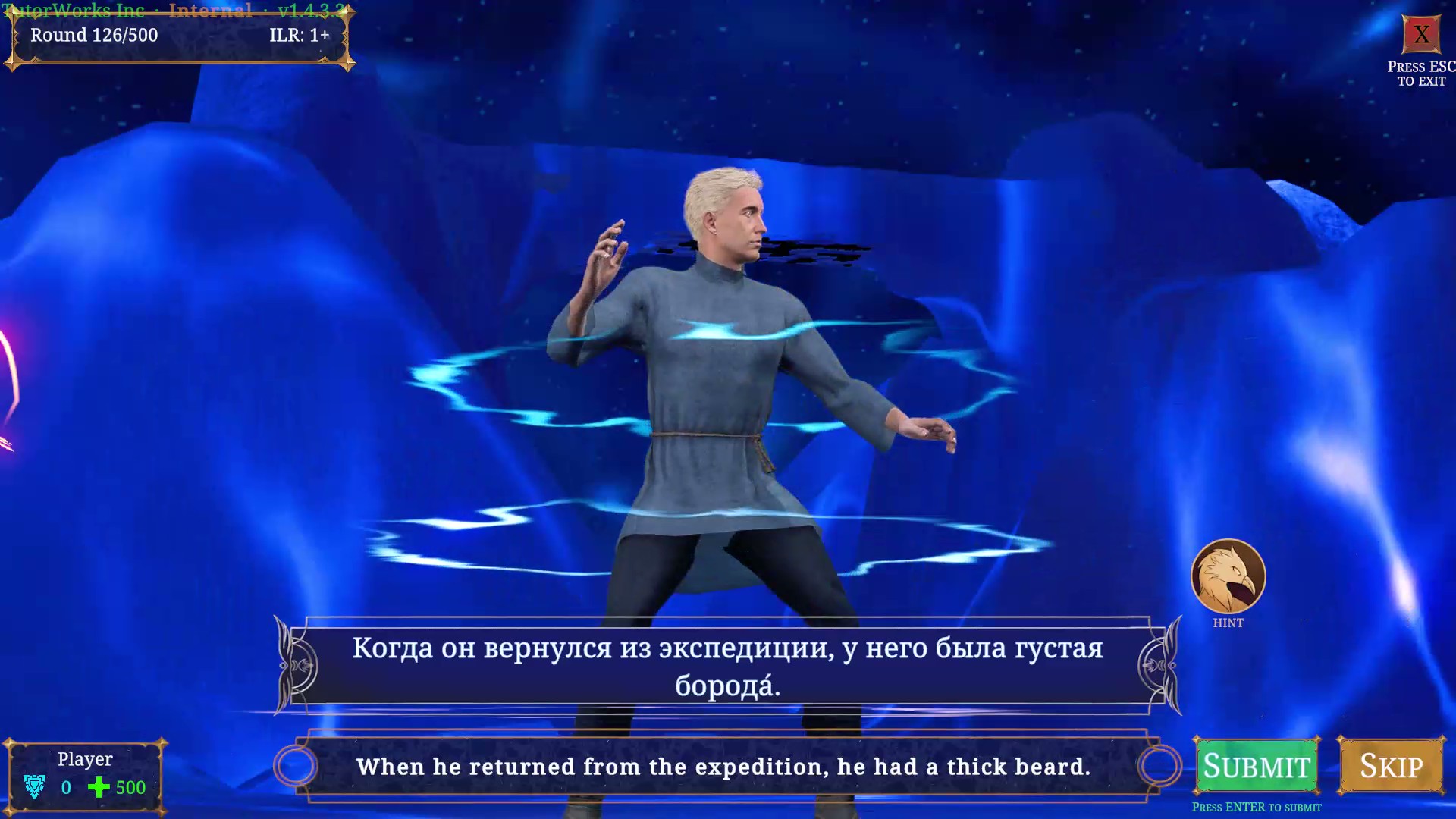
A March 2021 Phase II award provided approximately $750,000 to develop Mage Duel as a language acquisition tool. Phase II funds research and development, including efforts to build and demonstrate a proposed technology.
A separate 2023 Phase I effort explored generative AI for personalized content, adaptive comprehension questions and language prompts presented in context, using Mage Duel as the initial evaluation platform.
In June 2024, TutorWorks received approximately $1.5 million through a Tactical Funding Increase, or TACFI, award for continued Mage Duel development. TACFI provides additional Phase II funding to help mature technologies and strengthen the partnerships needed to move them toward military use.
Mage Duel also progressed into Phase III acquisition. Phase III funds work that builds on earlier SBIR efforts using money outside the program. It can include further development, purchases of products or services, and production.
A July 2022 Phase III contract provided approximately $750,000 for Mage Duel language software, with NSA/Central Security Service identified as the funding organization.
A March 2024 Phase III award for the 517th Training Group accumulated approximately $4 million in obligations, including funding added when an option was exercised in 2025. A separate 2026 follow-on purchase order added $121,420 for licenses and sustainment, with performance scheduled through Sept. 30, 2027.
TutorWorks is also exploring applications beyond language learning. A June 2026 Phase I award provided $74,989 for VANTAGE, a proposed training platform built on Mage Duel’s architecture. The effort combines modular content, AI agent interactions and game mechanics to explore training across additional Air Force mission areas.
Small businesses interested in developing technologies for Department of the Air Force mission needs can explore SBIR and STTR opportunities through the Defense SBIR/STTR Innovation Portal. Each solicitation outlines its technical requirements, eligibility criteria and submission deadlines.
*Disclaimer: References to non-federal entities do not constitute or imply Department of War or Air Force endorsement of any company or organization.
AFWERX SBIR/STTR Program Supports Progression from Prototype Toward Operational Use
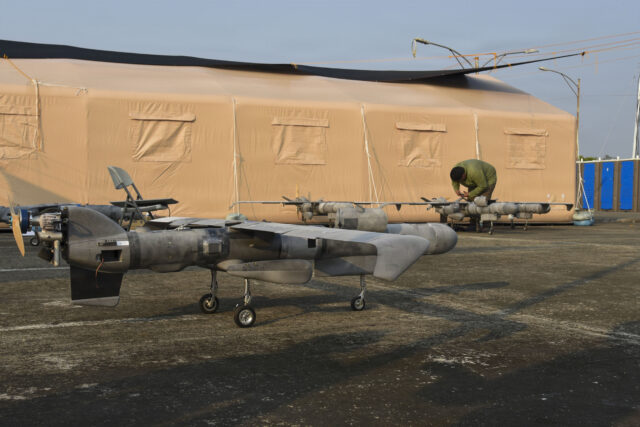
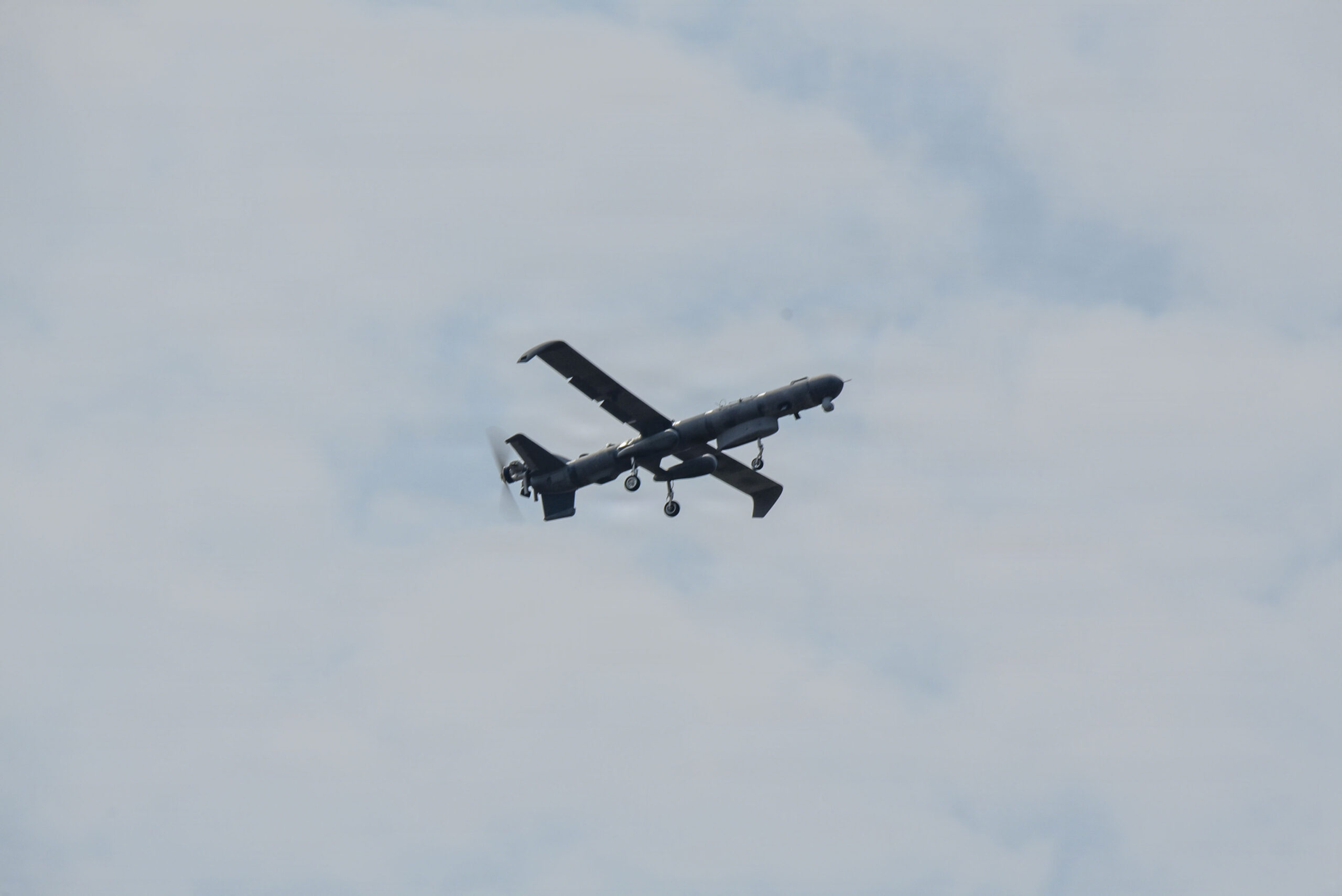
WRIGHT-PATTERSON AIR FORCE BASE, Ohio — A Firestorm Labs Tempest unmanned aircraft flying during Exercise Balikatan 2026 in the Philippines provides a recent example of technology that began its Department of the Air Force journey three years earlier through the Small Business Innovation Research program.
Transition is central to the AFWERX mission. As the innovation arm of the Department of the Air Force and powered by the Air Force Research Laboratory, AFWERX accelerates agile and affordable capability transitions by connecting technology developers with Airmen and Guardians and supporting technologies as they mature toward operational use.
Firestorm entered the AFWERX program in May 2023 with a Phase I SBIR contract for a low- cost, long-range, mission-adaptable unmanned aircraft system. The public award record states the effort was supported by the commander and deputy commander of Ninth Air Force and U.S. Air Forces Central’s Task Force 99.
Four months later, AFWERX awarded Firestorm a $1.25 million Phase II contract for its Expeditionary Manufacturing Cell, or xCell. The effort focused on mobile additive manufacturing intended to produce unmanned aircraft components in remote or austere environments and reduce dependence on traditional supply chains. Subsequent SBIR records identify Air Force Special Operations Command as the sponsor of Firestorm’s Phase II AFWERX Open Topic work.
In December 2024, the Air Force awarded Firestorm a $100 million-ceiling SBIR Phase III indefinite-delivery/indefinite-quantity contract for small unmanned aircraft systems, support services and research and development. The contract includes integration into the AFWERX Prime Proving Ground and research supporting Air Force autonomy efforts.
For small businesses, Phase III provides a mechanism to continue work derived from an earlier SBIR or STTR effort using non-SBIR/STTR funding. Phase III can support additional development, services, testing or production as technologies move toward potential government or commercial use.
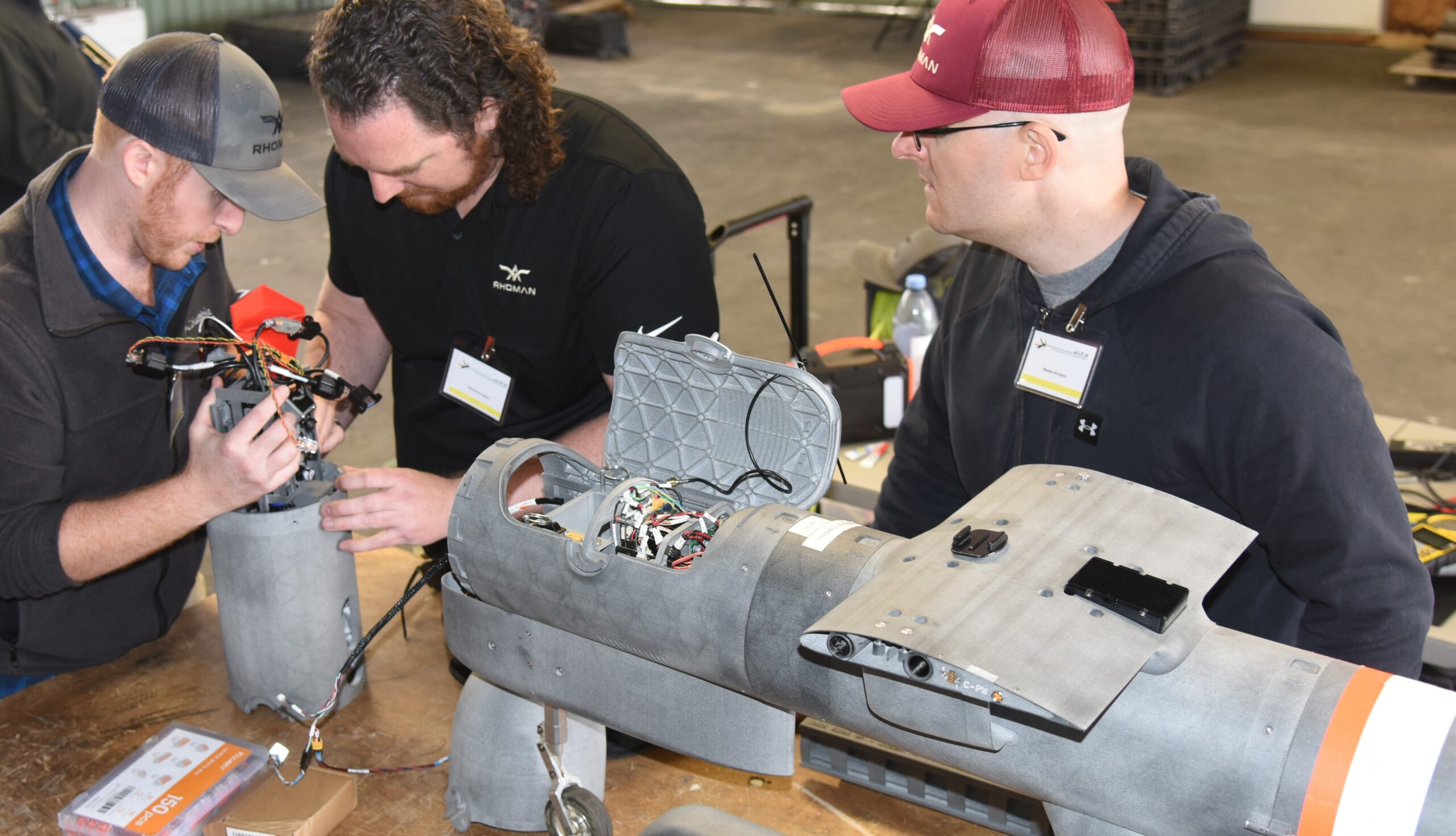
In February 2025, Firestorm operated xCell during a Naval Postgraduate School Joint Interagency Field Experimentation event at Camp Roberts, California, where Navy imagery documented modular Tempest components produced using the expeditionary manufacturing system.
The following month, AFWERX selected Firestorm for its Program Year 2025.1 Strategic Funding Increase opportunity. STRATFI is intended to bridge the gap between Phase II development and operational use by bringing together Department of the Air Force funding, matching investment and government transition partners.
That selection resulted in an xCell STRATFI contract. The Air Force announced the contract with a maximum value of $18 million, including $9 million obligated at award, to further develop the system, demonstrate production capability and collect data supporting future verification, training, operations and product support.
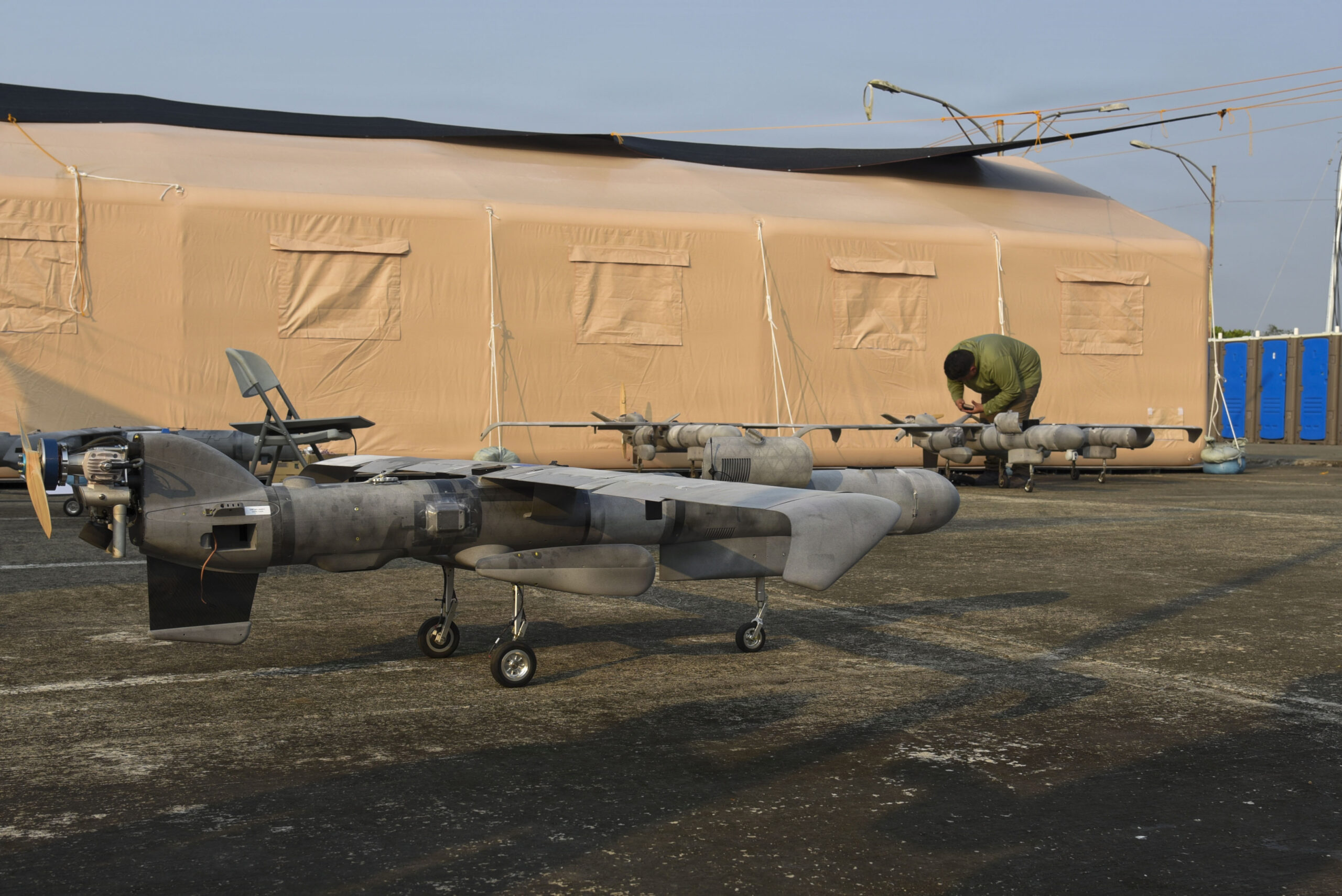
By April 2026, Department of War imagery documented the Tempest flying with 3rd Littoral Combat Team, 3rd Marine Littoral Regiment, during Exercise Balikatan 2026 at Cagayan North International Airport in the Philippines.
In May 2026, Firestorm announced it had received an Accelerate the Procurement and Fielding of Innovative Technologies award of up to $30 million to expand xCell deployment and Tempest production and sustainment for operational units in the Indo-Pacific. APFIT is a Department of War program separate from AFWERX that supports technologies moving from development toward fielding and initial production.
Firestorm’s progression from Phase I and Phase II through Phase III, STRATFI, joint experimentation and follow-on APFIT funding illustrates the transition pathways AFWERX seeks to create for small businesses — moving technologies beyond initial research and development and toward follow-on acquisition and potential operational use.
*Disclaimer: References to non-federal entities do not constitute or imply Department of War or Air Force endorsement of any company or organization.
AFWERX, SpaceWERX Advance DataEX Application: from Hackathon Concept to Digital Spaceport Capability
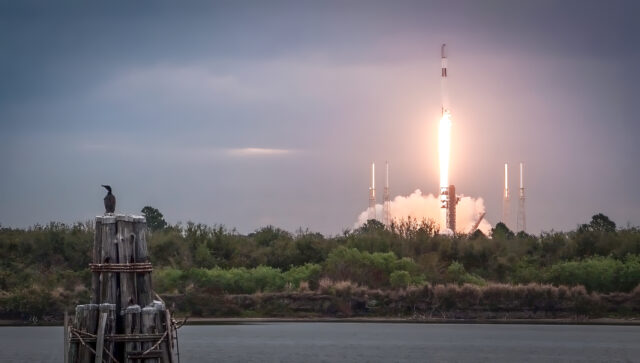
EL SEGUNDO, Calif. — An idea developed during a Space Launch Delta 45 (SLD 45) hackathon is being developed into a broader spaceport capability through collaboration among Beast Code, AFWERX, SpaceWERX and U.S. Space Force operators.
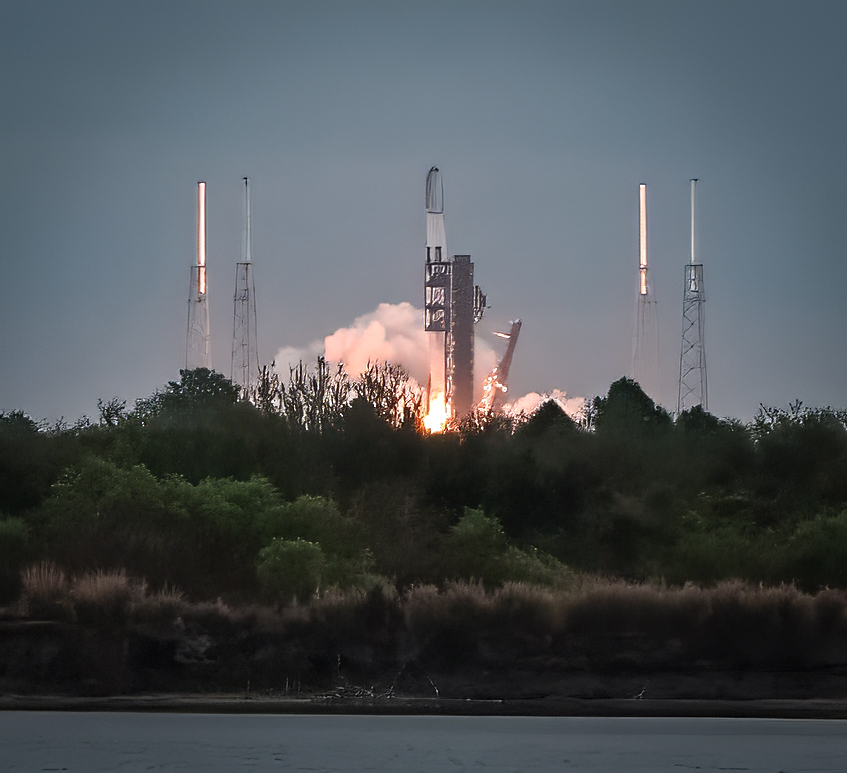
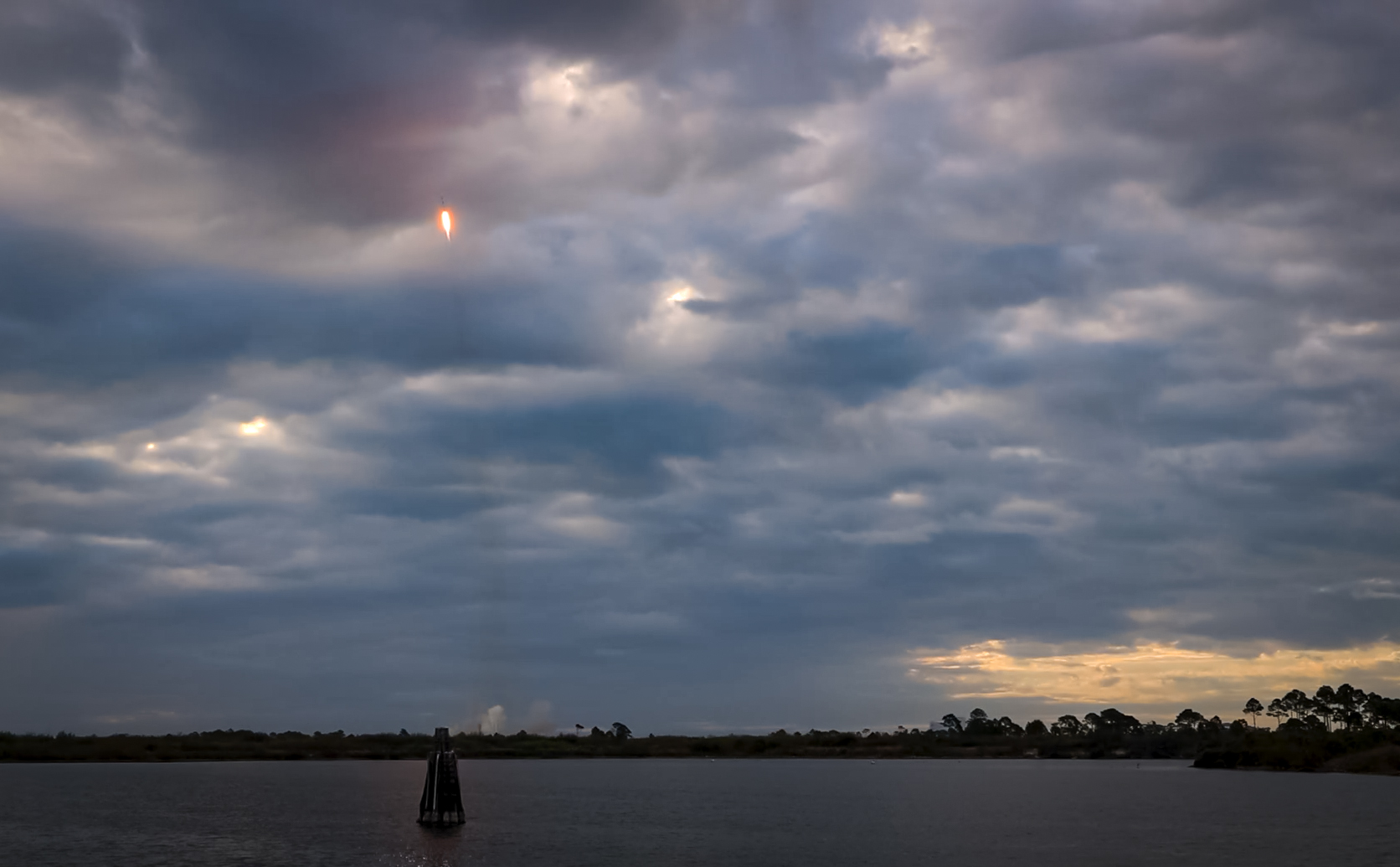
Annual launch activity at the Eastern and Western ranges supported a combined 175 launch missions in 2025, a significant increase from a decade earlier. Projections indicate the combined launch tempo could reach 650 to 700 or more launches annually by 2035, or roughly 13 launches per week. The increased launch and booster-recovery tempo is prompting spaceport organizations to evaluate existing processes, infrastructure and software tools. Projected launch rates could require operations to be managed on a daily rather than monthly basis, creating requirements similar in some respects to those of an airport.
DataEX, developed by defense software company Beast Code, is intended to provide Guardians and Airmen with digital tools for planning, coordination and execution of spaceport activities. The application combines information from multiple systems, databases and mission sets into a common operating picture intended to help users access relevant information in an environment where conditions can change rapidly.
The effort began in April 2023, when Beast Code software developers participated in an inaugural hackathon at Patrick Space Force Base, Florida. Working with SLD 45 operators and innovation teams, the company developed an initial spaceport visualization concept focused on helping users plan and coordinate installation activities.
AFWERX and SpaceWERX subsequently selected Beast Code to support its Digital Spaceport of the Future initiative, which seeks to examine ways to integrate and automate spaceport operations as launch activity increases. Through two related Small Business Innovation Research Phase II contracts, Beast Code began developing the DataEX application and supporting data infrastructure to connect existing spaceport systems with cloud-based capabilities.
In October 2025, SpaceWERX awarded Beast Code a four-year, $15 million Strategic Funding Increase (STRATFI) contract to further develop the effort. Initial work focused on SLD 45 operations at Patrick Space Force Base and Cape Canaveral Space Force Station. The effort is also being evaluated for potential application to other U.S. Space Force operations, including Space Launch Delta 30 at Vandenberg Space Force Base, California.
According to Beast Code, the DataEX effort incorporates requirements identified through discussions with personnel from Spaceport Integration, now designated the 1st Space Launch Squadron, as well as the 45th Safety Squadron, 1st Range Operations Squadron, 45th Range Management and digital transformation offices. The company used those discussions to identify information and workflow requirements for the application.
DataEX is built on Beast Code’s software framework and is designed to bring information from multiple existing sources into a consolidated view without requiring wholesale changes to the systems that generate or transmit the underlying data. The application currently displays information including Star Gate launch schedule data, ground movements, safety zones, security roadblocks, construction zones, hazard areas and user-generated events. The information is intended to support situational awareness, planning, coordination and deconfliction among participating units.
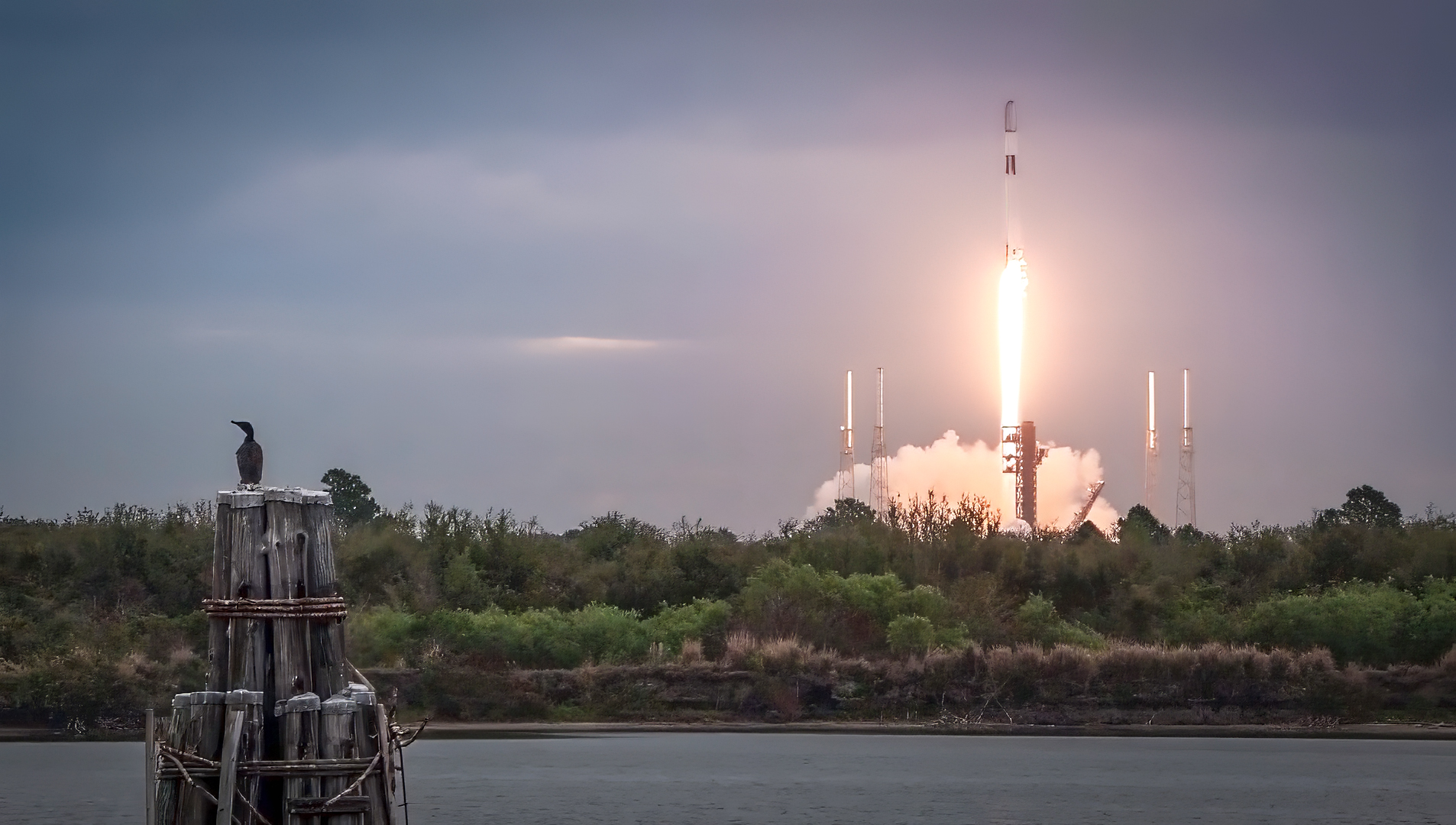
The development of DataEX from a five-day hackathon prototype into a project supported through a STRATFI contract illustrates how operational requirements identified by users can inform the development and evaluation of emerging technology.
SpaceWERX works with industry, government organizations and military users to identify and develop technologies that may address U.S. Space Force requirements. The DataEX effort is one example of that process, moving from an initial concept to continued development and evaluation in an operational environment.
*Disclaimer: References to non-federal entities do not constitute or imply Department of War or Air Force endorsement of any company or organization.
AFWERX, SpaceWERX Supports Development of AI Technology for Guardian Information Discovery
DAYTON, Ohio — Today’s military operations often require rapid access to information to support planning and decision-making. For U.S. Space Force analysts, locating relevant information across a vast number of sources and agencies can be time-consuming and may increase cognitive workload, potentially affecting mission planning and operational decisions.
As the volume and complexity of data continue to grow, identifying relevant information and synthesizing it into useful context has become an increasingly important operational challenge. Personnel supporting military operations often require timely access to information to assist with mission planning and execution.
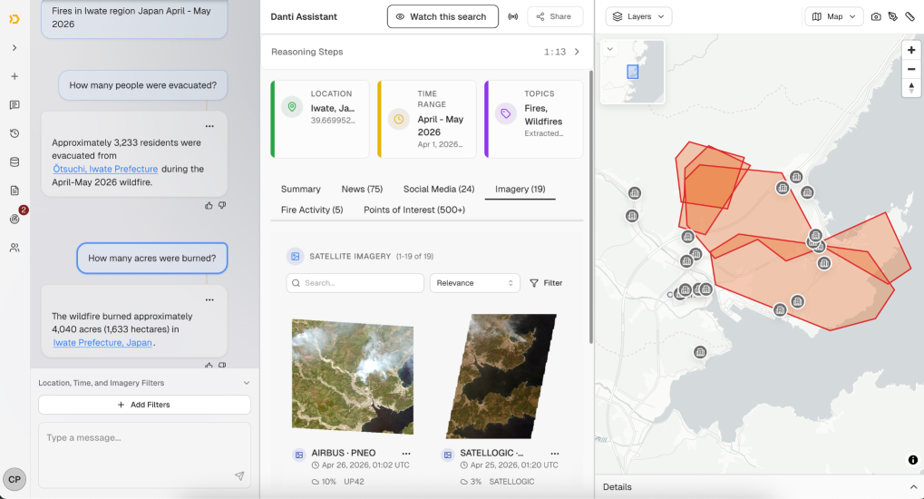
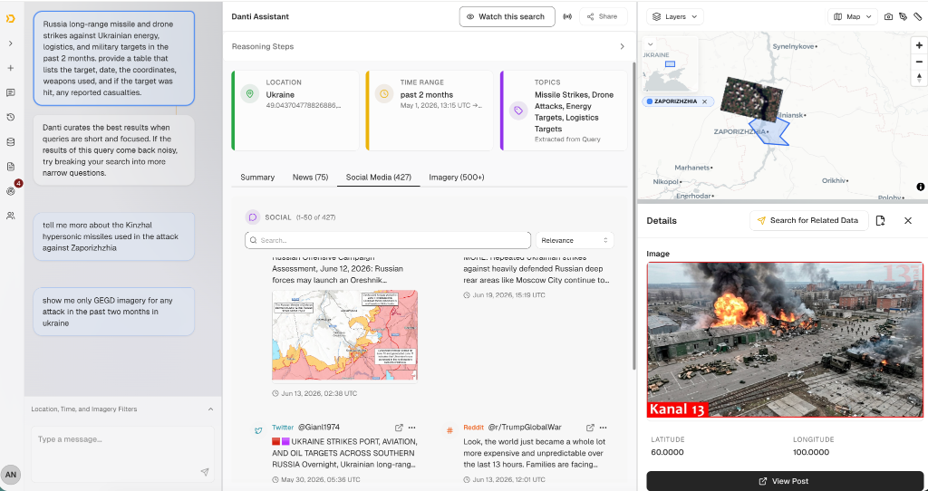
To support this effort, SpaceWERX awarded Danti a contract to accelerate the development and transition of an artificial intelligence-powered, agentic intelligence platform intended to help Guardians discover, organize and analyze mission-relevant information.
In 2023, SpaceWERX awarded Danti a Direct-to-Phase II contract to build, test and refine the technology for potential operational transition. In 2024, Danti received a Tactical Funding Increase (TACFI) award to further develop and scale the technology for commercial applications.
U.S. Special Operations Command Europe (SOCEUR) used the Danti platform during the Trojan Footprint 2026 exercise. Ground advisers used the platform to provide unclassified, space-enabled responses to critical requests for information from Georgian Special Operations Command (GSOC) operators executing tasks in the field.
According to Danti, the platform enables users to search data using natural language rather than complex search syntax. The technology is intended to interpret the context of a user’s question, automate search, retrieval and analysis tasks, and provides responses that include source attribution.
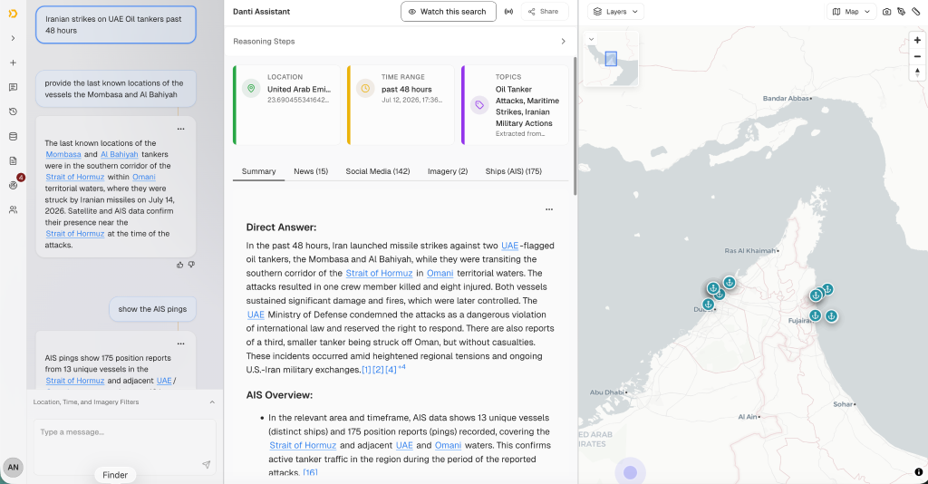
The platform is designed to integrate information from multiple data sources, including commercial providers and government agencies, into a single search experience. According to the company, this approach can help users locate geospatial information, imagery and other operational data more efficiently.
The platform is intended to reduce the time and expertise required to search across multiple datasets, allowing personnel to focus more on analysis and mission support. According to Danti, the technology can support workflows such as correlating space-based imagery and signals with publicly available news and social media content and automating portions of the reporting process.
The platform’s AI-enabled search and workflow capabilities are also designed to help users identify relationships among data that may be difficult to detect through manual search processes. Faster access to relevant information may support planning and decision-making in dynamic operational environments.
As the U.S. Space Force continues to modernize its digital capabilities, the service is evaluating technologies intended to improve data accessibility and operational efficiency. Through collaboration with commercial companies, the service can assess emerging technologies that address evolving operational needs.
This collaboration provides the Space Force an opportunity to evaluate how commercial AI technology may help Guardians transform large volumes of mission data into information that could support operational decision-making.
*Disclaimer: References to non-federal entities do not constitute or imply Department of War or Air Force endorsement of any company or organization.
AFWERX Supports Development of Modular Fuel Technology for Contested Environments
DAYTON, Ohio — Fuel distribution remains a significant logistical challenge for military operations in contested and remote environments. Conventional fuel supply chains often rely on transportation routes, large storage infrastructure and frequent resupply missions that can increase operational risk, limit mission endurance and place additional demands on personnel.
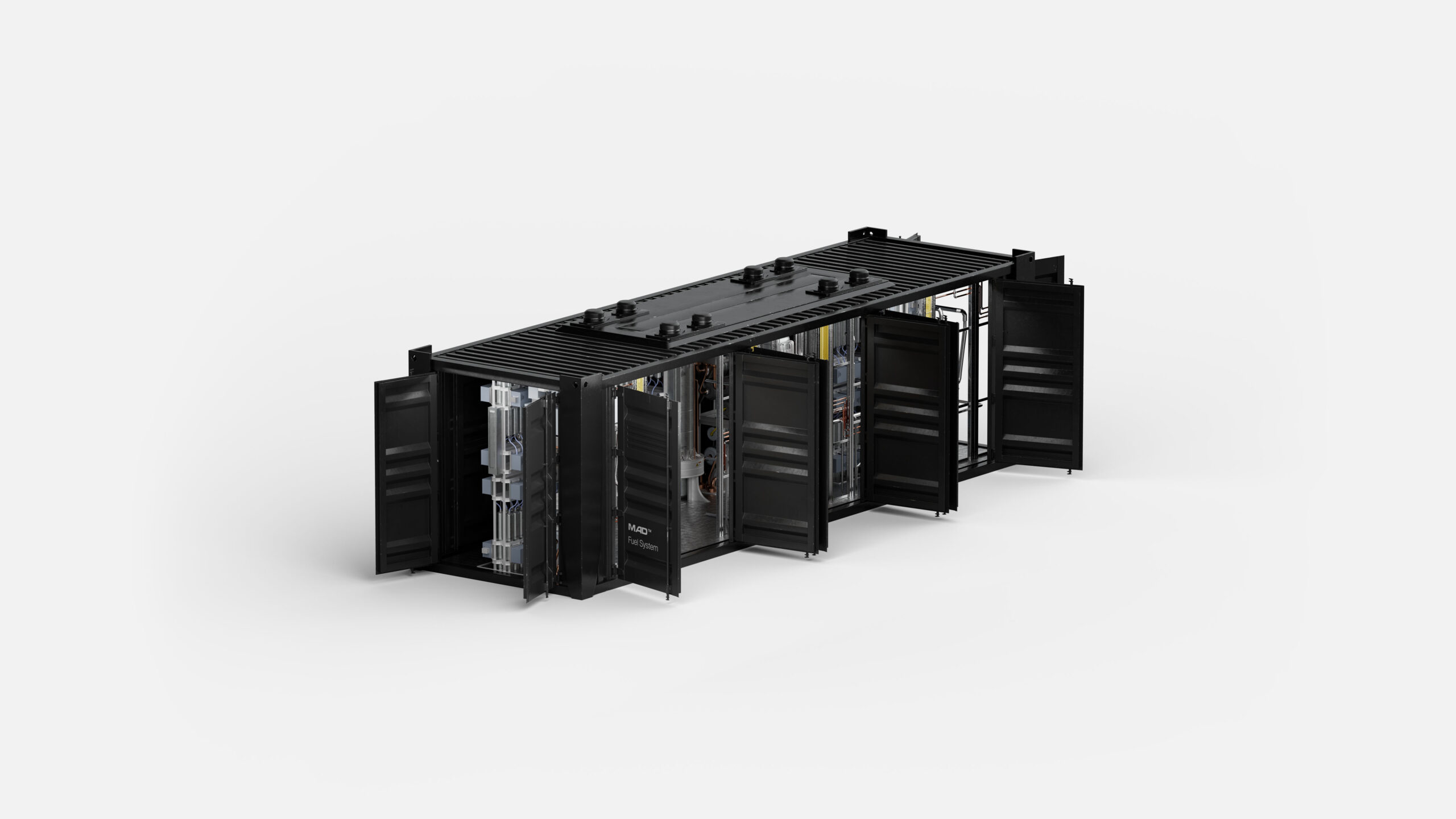
AFWERX awarded AIRCO, a carbon-conversion technology company, a $15 million Strategic Funding Increase (STRATFI) contract to continue development of its Mobile, Adaptable and Deployable (MAD) Fuel System.
AFWERX’s STRATFI award is part of the Small Business Innovation Research (SBIR) program, which provides funding to small businesses developing technologies with potential applications for the Department of the Air Force and the Department of Defense.
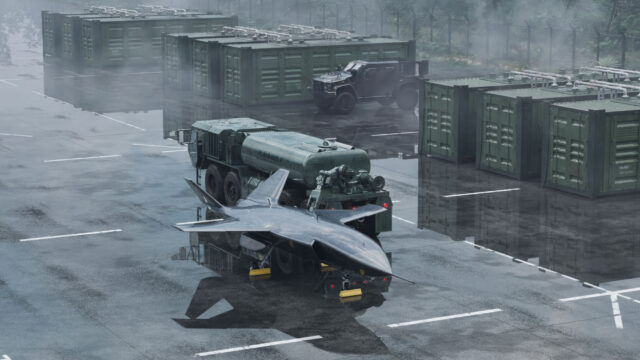
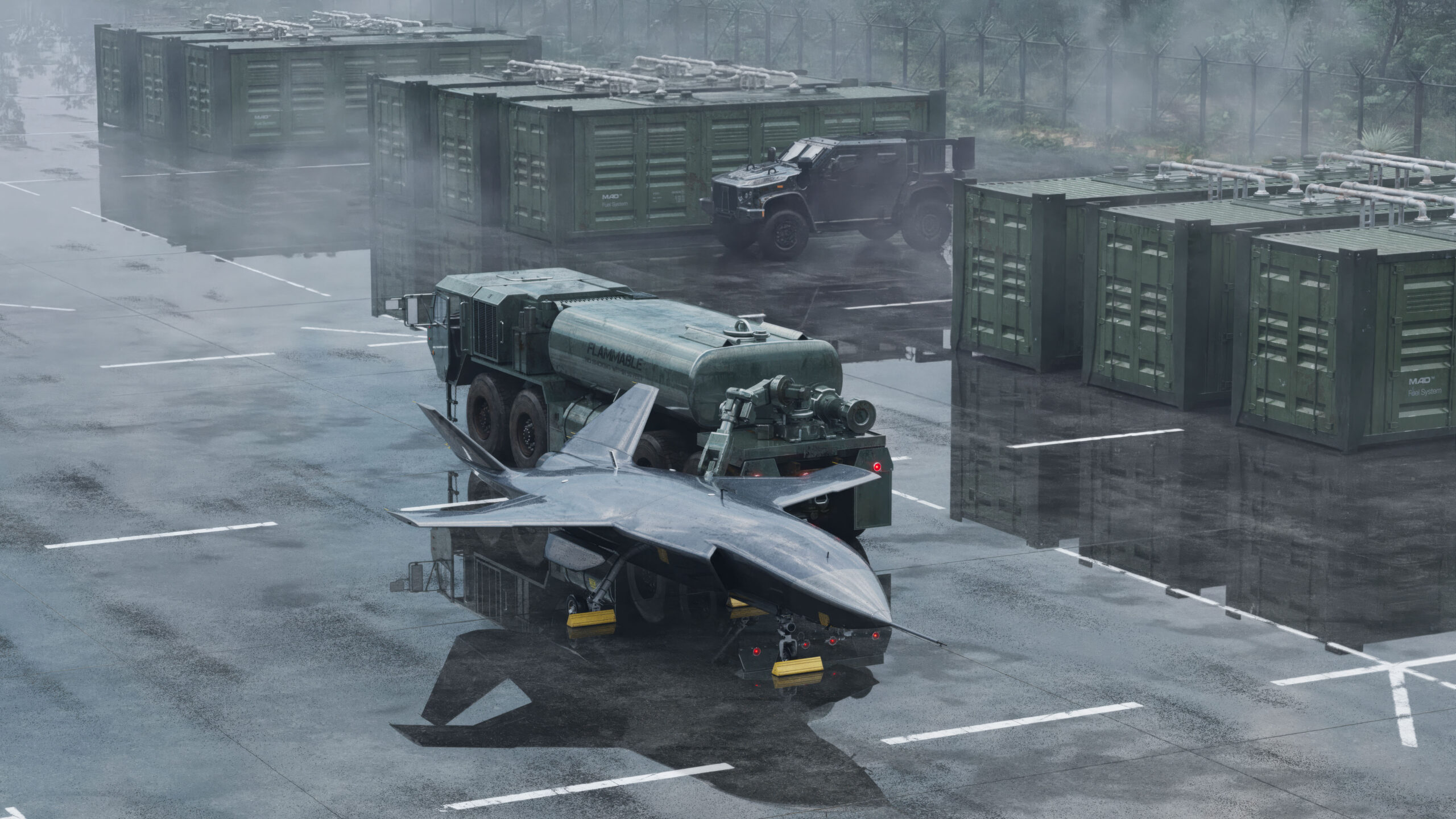
The technology is a containerized platform designed to produce synthetic jet fuel or diesel fuel at or near the point of use. According to the company, the system captures carbon dioxide and produces hydrogen from locally available sources, converting them into liquid hydrocarbon fuel.
The approach is intended to reduce reliance on traditional fuel delivery methods.
If development and testing are successful, the system could provide another option for fuel production during expeditionary operations. It could allow units operating in remote or dispersed locations to produce fuel closer to the point of use, rather than relying solely on fuel transported from established supply hubs.
The technology also is being considered in connection with Agile Combat Employment concepts, which emphasize the ability to operate from distributed locations.
Other Department of Defense organizations involved in the continued development of the fuel system include the Defense Logistics Agency, the Air Force Petroleum Office and the 12th Air Task Force. Planned next steps include fuel qualification activities and support for AIRCO’s planned commercial demonstration plant.
Distributed logistics remains a key component of Department of the Air Force operational planning for contested environments. Technology could potentially increase operational flexibility and reduce logistical demands in austere locations.
AIRCO’s work demonstrates how AFWERX can help advance emerging technologies from development toward potential operational applications. Through collaboration with industry and investment in innovative solutions, AFWERX helps address technology challenges that could affect future warfighter capabilities.
*Disclaimer: References to non-federal entities do not constitute or imply Department of War or Air Force endorsement of any company or organization.
AFWERX SBIR/STTR Program Supports Faster Software Deployment
DAYTON, Ohio — Modernized software has the capability to transform existing military hardware into agile systems that bolster Department of the Air Force missions. However, commercial companies often encounter barriers within the acquisition process, limiting opportunities for software modernization and allowing capability gaps to persist.
Traditionally, Commercial Solutions Openings (CSOs) served as an alternative and specialized competitive pathway. CSOs were typically confined to specific agencies and used sparingly to seek rapid prototypes through Other Transaction Authority (OTA).
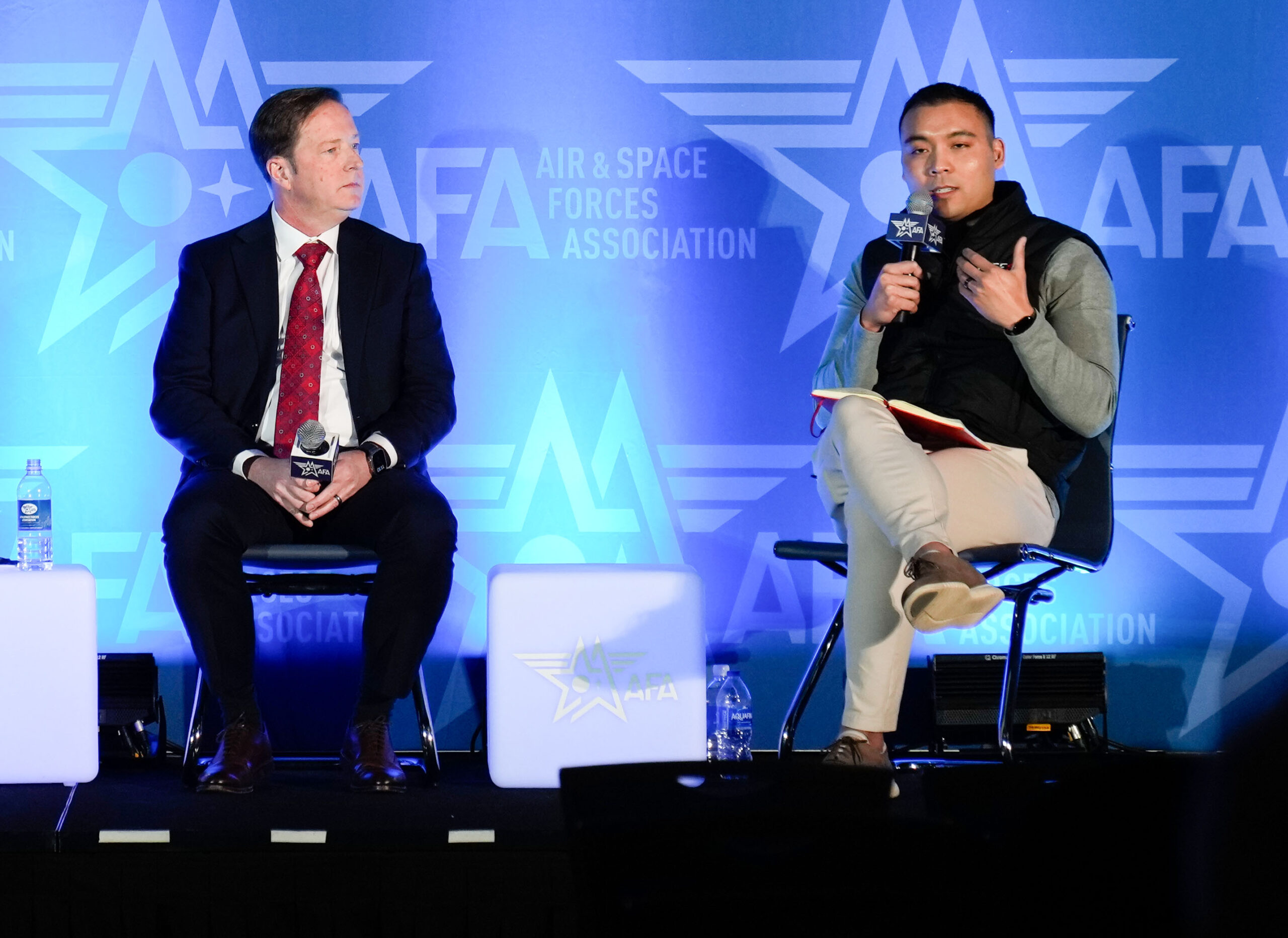
On March 6, 2025, Secretary of Defense Pete Hegseth underscored the importance of shifting the acquisition framework from a hardware-centric model to a software-centric approach. The initiative focuses on performance-based outcomes that deliver capabilities to the warfighter at speed and scale.
Innovation and prototype development remain a top priority for senior government leaders seeking to strengthen warfighter capabilities. Delivering those modernized advancements into operational use is the greatest barrier to mission capacity. Many technologies never progress beyond development because the software delivery process cannot keep pace with operational demands.
As threats continue to evolve across air, space, and cyber domains, streamlining access to emerging technologies will enable Airmen and Guardians to rapidly adapt, improve decision-making and maintain a competitive advantage against United States adversaries.
Rise8 Software Delivery Organization (SDO)
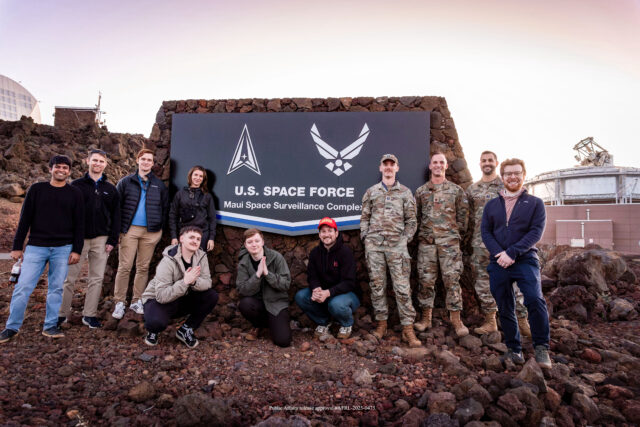
With support from AFWERX, Rise8, a Tampa, Florida-based digital transformation and software development firm, is supporting software delivery efforts focused on autonomy, software transition programs and other government initiatives.
Rise8’s AFWERX Software Delivery Organization (SDO) SBIR began with a Phase I award in November 2022. The efforts were geared toward validating how Rise8’s modern software delivery methods, DevSecOps practices, cloud-native engineering approach, and enablement model could be adapted for government.
In 2023, Rise8 worked with AFWERX Autonomy Prime to derive, extend and complete the proposal through a SBIR Phase III Indefinite Delivery/Indefinite Quantity contract (IDIQ) with an initial $100 million ceiling.
In 2024, Rise8 developed the Blitzar satellite communication resource request portal under an open topic, Direct-to-Phase II SBIR contract. Blitzar works across multiple spectrum bands and provides support to combatant commands globally, allowing their personnel to request satellite communications resources. Rise8 later received a Tactical Funding Increase (TACFI) to continue maturing the capability, and the effort ultimately transitioned into a Phase III task order under Rise8’s AFWERX SDO IDIQ.
In 2025, Rise8 secured an increase from $100 million to $499 million for the AFWERX SDO Indefinite Delivery Indefinite Quantity (IDIQ) contract vehicle. Rather than waiting months or years for major software releases, program managers can deploy incremental updates based on operational feedback and changing mission requirements. The SDO contract vehicle helps transition prototypes into production software through funded task orders and interactive software delivery. Organizations that have issued task orders through the IDIQ include:
- United States Air Force Kessel Run
- United States Air Force Unified Platform
- United States Air Force 309th Software Engineering Group
- United States Air Force AFWERX
- United States Space Force System Delta 84 Future Operationally Resilient Ground Evolution
- United States Space Force System Delta 88 Enterprise Management and Control
- United States Space Force Combat Forces Command Space Operations Command/Combat Force Enhancement
- United States Space Force Mission Delta 2 15th Space Surveillance Squadron
- United States Space Force Space Launch Delta 45
- Department of Veteran Affairs OIT Lighthouse
The collaboration between AFWERX and Rise8 illustrates one approach to transitioning software capabilities from prototype development into operational use. This partnership has guided ideas across the “valley of death” and into operational impact. Both organizations recognized that one of the biggest barriers to DoW software innovation is not a lack of ideas. It’s the inability to deliver software into production at speed and scale.
Rise8 is currently working on refining the vehicle to ensure it remains useful to the government. Future work under the contract is expected to support government efforts related to responsible artificial intelligence adoption, enablement, and implementation.
*Disclaimer: References to non-federal entities do not constitute or imply Department of War or Air Force endorsement of any company or organization.
AFWERX SBIR/STTR Program Decreases Manpower Demand for Drone Operators
DAYTON, Ohio — On June 1, 2025, Ukrainian forces launched Operation Spiderweb, a coordinated drone attack targeting Russia’s long-range military aircraft at several airbases in Russian territory. According to public reporting, the complex operation involved launching 117 drones from wooden containers carried on flatbed trucks. Individual pilots, each using open-source software, guided their assigned drone to its target, damaging or destroying 40 aircraft, including bombers and a large transport plane. While effective, this approach required the Ukrainian military devoting one pilot per vehicle.
Command and control software developed by Autonodyne, a Boston, Massachusetts tech company, with support from AFWERX and the Department of Defense, turns the ‘one pilot, one drone’ approach on its head, expanding efficiency and lethality wielded by a warfighter.
Autonodyne’s software allows a single warfighter to simultaneously control multiple drones from different manufacturers, working with different datalinks, sensors and handheld devices.
The company took this approach on purpose, said Steve “Jake” Jacobson, Autonodyne’s founder and chief executive officer.
“We are a software company,” Jacobson said. “We’re not an OEM maker. We’re not making vehicles. The world isn’t going to bend to our designs. Our designs have to support this universe of different combinations of protocol, datalinks and user devices, computer environments, all kinds of stuff.”
The software’s agnostic nature fosters private-sector competition and innovation by allowing the Department of the Air Force to work with various OEMs without being locked into a single platform.
The company’s technology also allows users to pair unmanned vehicles with crewed forces to plan and conduct successful missions. The software has also been used to conduct Red Team testing of drone defenses at U.S. military bases.
Autonodyne and AFWERX
Drones have been and will remain a critical piece of Air Force efforts to increase survivability and generate combat power by quickly deploying and operating from dispersed locations, rather than relying only on a few main bases.
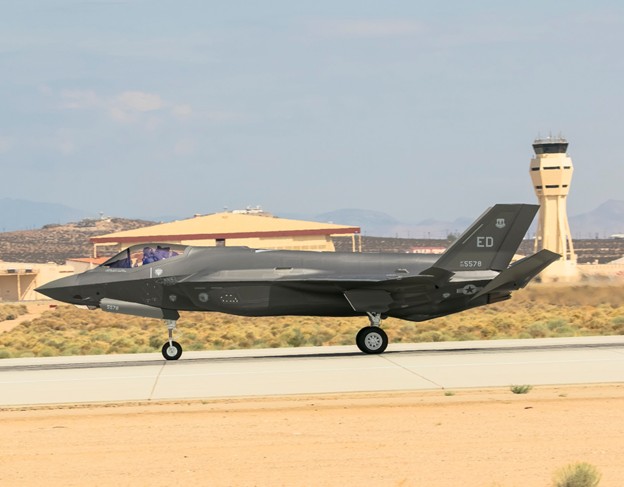
Drones such as the MQ-9 Reaper and the Collaborative Combat Aircraft (CCA) align with this strategy by providing Intelligence, Surveillance and Reconnaissance (ISR), rapid deployment, Manned/Unmanned Teaming (MUM-T) and Counter (C-UAS) capabilities.
As part of the DAF’s efforts to gain a strategic edge with unmanned systems, Autonodyne began working with AFWERX in December 2019 when it received a Phase I contract. The agreement called for the company to look for ways to adapt its commercial common control station software, adding more autonomy behaviors that are optimized for Air Force Special Operations Command warfighters.
That work led to the company landing a Phase II SBIR worth nearly $3 million. The July 2021 contract called for Autonodyne to continue working with its common control station and autonomy behaviors, rapidly expanding the capabilities available to the Air Force, other military service branches and commercial users.
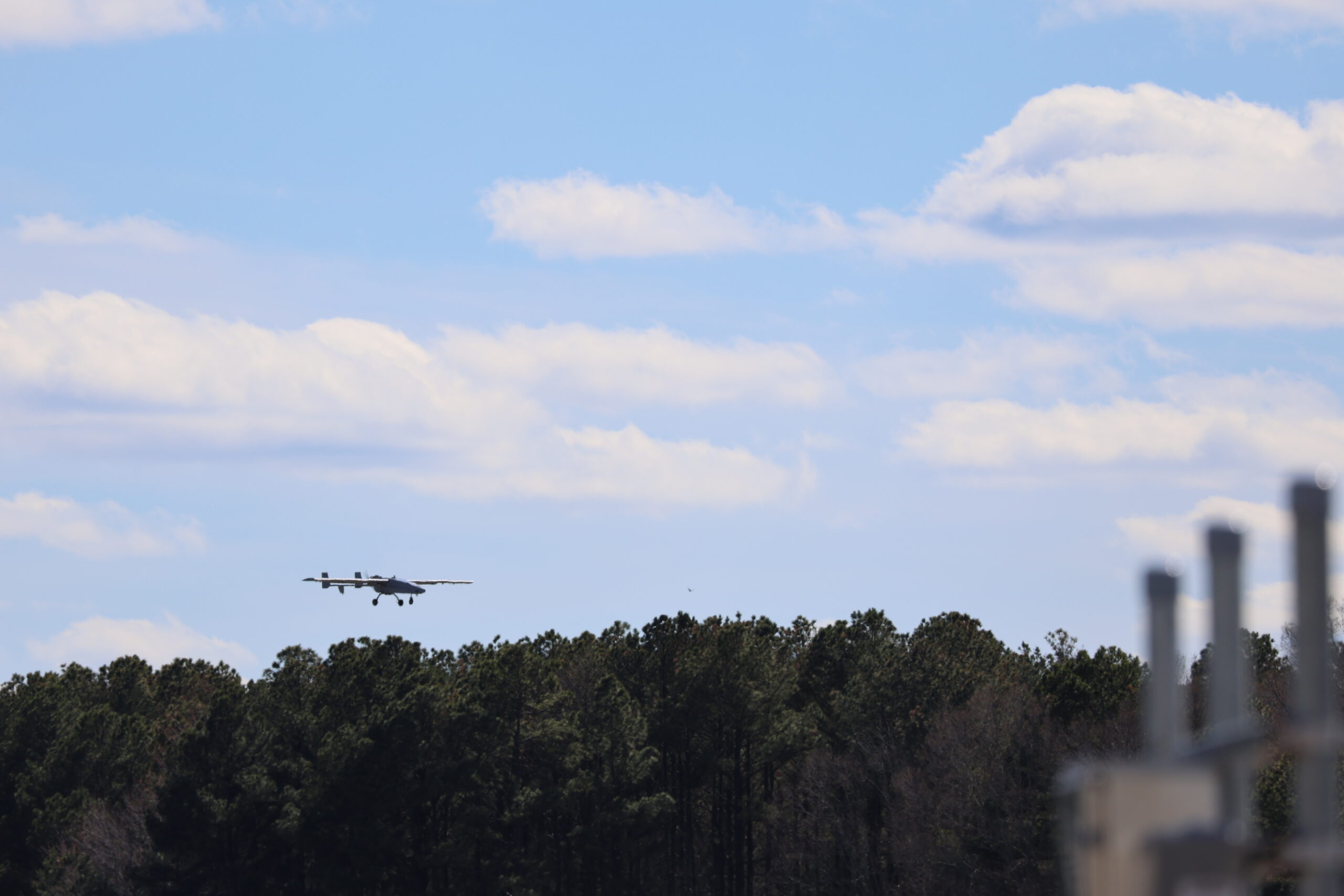
In February 2023, AFWERX awarded Autonodyne a $521,150 Phase III contract focused on using drone swarms to check military bases for vulnerabilities in their UAS defenses.
Several months later, in August 2023, the company received a $687,000 Phase III contract from Kessel Run, formally known as the Air Force Life Cycle Management Center (AFLCMC) Detachment 12. The contract from Kessel Run, a software development enterprise located in Boston and at Hanscom Air Force Base, Massachusetts, funded Project Free Flight, an effort focused on autonomous scouting.
The following year, in March 2024, AFWERX awarded Autonodyne a Phase III contract totaling $4 million to work on autonomous system integration and development as well as software development for human interfacing with the control systems.
Under the contract, Autonodyne developed a library of autonomy behaviors that could be accessed manually, or in more advanced scenarios, be automatically stitched together with a set of high-level automation tasks for real-time autonomous control of dynamic system behaviors.
In May, AFWERX awarded the company a $1.5 million Phase III contract, funded by the Advanced Aircraft Division, part of the AFLCMC Fighters and Advanced Aircraft Directorate. The agreement could reach $17.5 million. It calls for Autonodyne to deliver ‘software vehicle control integration and development’ to the division.
Autonodyne’s success demonstrates how AFWERX’s approach directly supports broader national priorities. By investing in a small, domestic business, AFWERX not only delivered a critical military capability but also bolstered the nation’s defense industrial base. The agnostic nature of the software promotes competition among U.S. manufacturers, preventing vendor lock-in and ensuring the DAF has access to the best technology on the market. This case study is a testament to the power of public-private partnerships, illustrating how targeted government investment can accelerate innovation, drive economic growth and strengthen the military to meet future challenges.
*Disclaimer: References to non-federal entities do not constitute or imply Department of War or Air Force endorsement of any company or organization.
AFWERX SBIR/STTR Program Strengthens Warfighters’ Knowledge Retention
DAYTON, Ohio — U.S. Air Force missions depend on Airmen’s ability to receive and retain skills as they advance in their career fields. Extensive training hours, equipment and funding have historically been vital to building confidence and qualifying warfighters before they perform live mission operations.
Traditional training methods face challenges that limit engagement, hands-on experience and the knowledge retention required to achieve optimal force readiness without extensive spending. Instructors also experience constraints because of location requirements, scheduling and asset availability. For specialized career fields, these delays can affect the Air Force’s ability to maintain mission readiness.
Limited access to aircraft and airspace for pilot training can restrict opportunities for pilot training, while damaged aircraft reduces fleet availability and disrupt operations supporting U.S. defense missions worldwide. For maintainers, diagnosing system faults and repairing complex aircraft requires technical proficiency, and errors can result in additional damage or extended maintenance timelines. Medical personnel and first responders also must develop and maintain critical skills to perform effectively in high-stress environments where mistakes can have operational consequences.
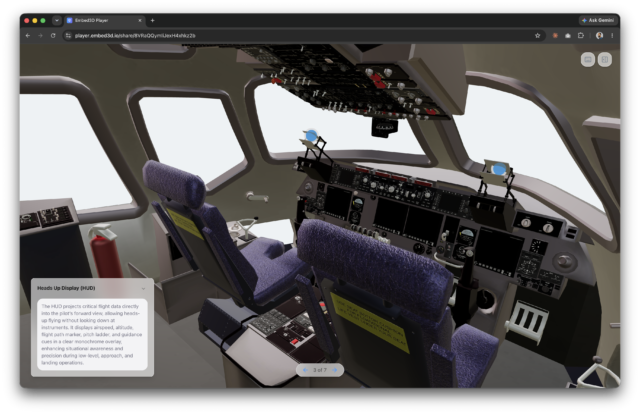
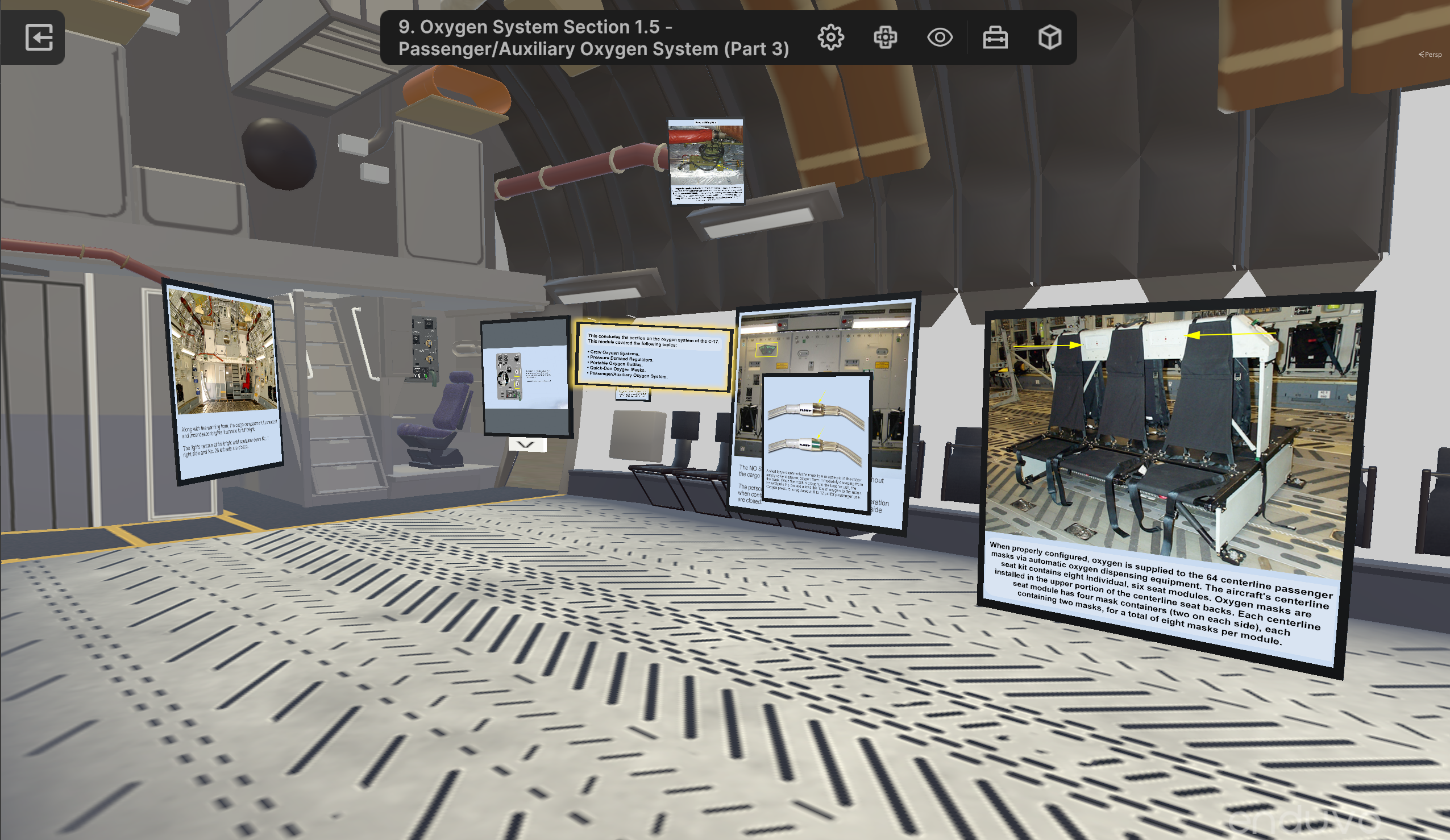
With support from AFWERX and the Department of the Air Force, Enduvo, a Peoria, Illinois-based company that develops immersive content creation software, is working to address these challenges by leveraging an AI-native no-code, collaborative virtual classroom.
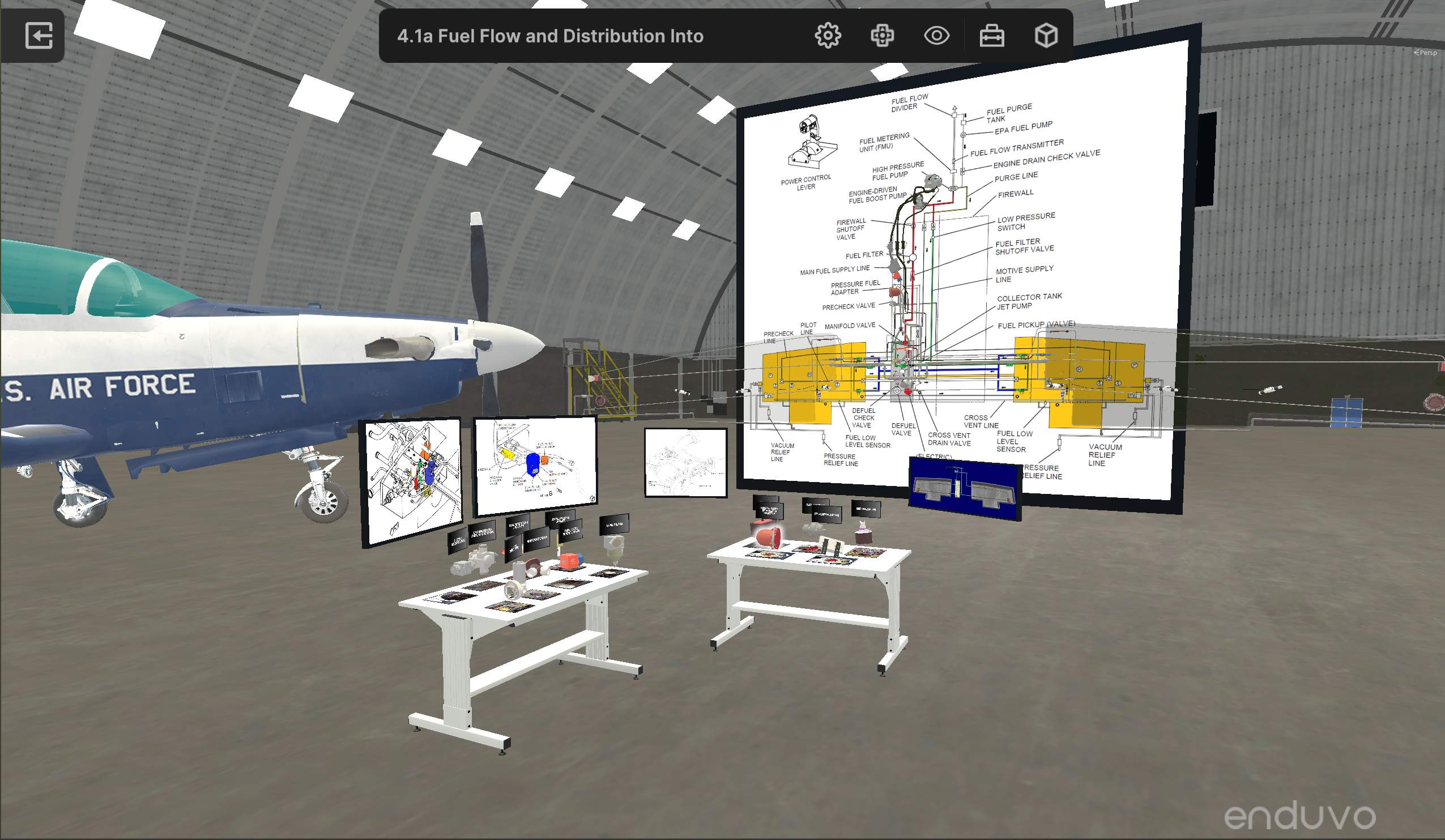
Enduvo develops immersive training software used to support military training initiatives. The company’s platform enables trainers to develop immersive training content using no-code authoring environments. With this platform, users can develop interactive training scenarios for collaborative instruction that help warfighters retain information.
In 2019, Enduvo received an AFWERX Small Business Innovation Research (SBIR) Phase I award to evaluate and adapt its augmented reality and virtual reality (AR/VR) content authoring platform. It was designed to help military teams train pilots, medical practitioners, and maintenance crews with the goal of reducing training costs.
In 2022, Enduvo was awarded AFWERX Tactical Funding Increase (TACFI) contract to scale its immersive, no-code AR/VR authoring platform.
In 2023, the company received an AFWERX SBIR Phase III contract to be a core element of the U.S. Air Force’s Discovery Analysis and Reporting Platform (DARP)/ Member Operations Training Analysis and Reports (MOTAR) program of record. Air Force trainers gained the ability to build immersive content within their digital classroom and connect with the MOTAR ecosystem.
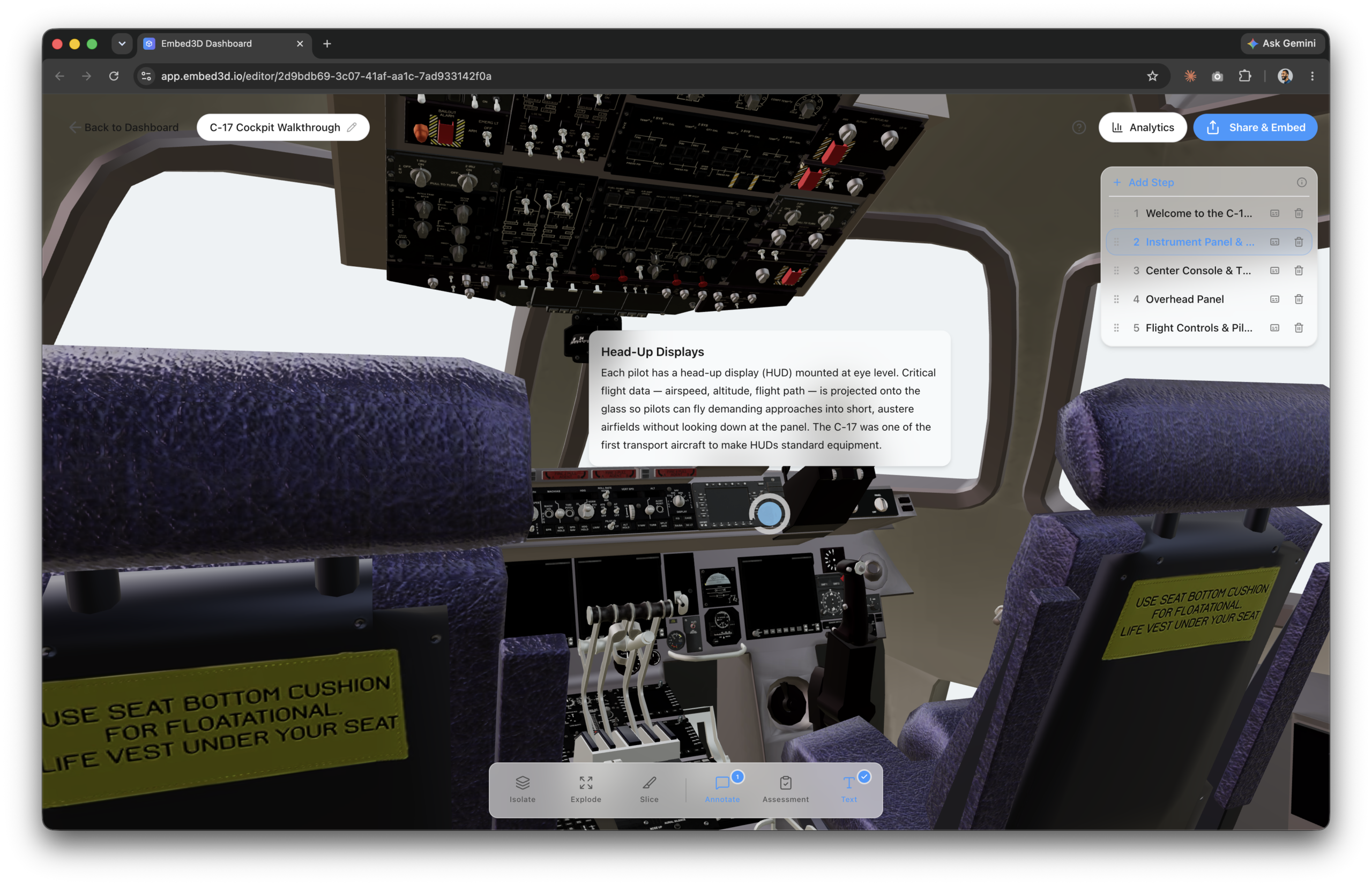
Later that year, Enduvo won a $10 million enterprise wide Indefinite Delivery, Indefinite Quantity (IDIQ) contract from the U.S. Air Force for an immersive learning platform. The company is currently engaged in a second TACFI effort to deploy generative AI to the platform to decrease the time it takes instructors to create and modify training content.
This effort illustrates how AFWERX works with industry through the SBIR/STTR program to evaluate, mature and transition commercial technologies that address DAF mission needs. By incorporating an immersive training platform, the U.S. Air Force is refining the education and training process and supporting Airmen’s readiness.
*Disclaimer: References to non-federal entities do not constitute or imply Department of War or Air Force endorsement of any company or organization.